Components of an Oil Seal

What are the Main Components of an Oil Seal?

Introduction

Oil seals are essential for preventing lubricant leakage and blocking contaminants in rotating machinery. Choosing the right seal begins with understanding the components of an oil seal each designed for durability, performance, and precision. The components of an oil seal are often overlooked, but they play a key role in the reliability and service life of industrial equipment.

What is an Oil Seal Made Of?

An oil seal is composed of three core elements – an outer shell, a sealing lip, and a spring. Each part contributes uniquely to the function and resilience of the seal. Understanding the components of an oil seal helps engineers match the product to specific performance requirements.
  • Shell: Gives structural support
  • Lip: Provides a flexible sealing barrier
  • Spring: Maintains contact pressure for effective sealing
These parts of an oil seal work together to prevent fluid leaks and contamination in high-speed industrial environments.

What Are the Main Components of an Oil Seal and Its Functions?

Understanding the purpose of each part is critical for selecting a seal that fits specific industrial needs. Below is a deeper look at each component based on standard oil seal construction. Whether for OEM systems or aftermarket replacements, selecting oil seals with the right design ensures long-term equipment reliability.

The Outer Shell: Structure and Material

The outer shell is the rigid casing of the oil seal, giving it structural integrity and a secure fit. This is one of the primary components of an oil seal that ensures secure installation under varying operating conditions.
  • Material: Stainless steel or carbon steel
  • Function: Holds the seal in position and resists pressure, vibration, and heat
  • Relevance to Oil Seal Construction: Acts as the mechanical anchor inside the bore

The Sealing Lip: Ensuring Leak-Proof Functionality

This is the most important part of the oil seal, creating a tight, flexible barrier against fluid loss. It’s a crucial element in the overall oil seal design and directly influences performance under thermal and chemical stress.
  • Material: Nitrile rubber (NBR), fluorocarbon (FKM), or silicone
  • Function: Maintains contact with the shaft to retain lubricant and block contaminants
  • Connection to Oil Seal Design: Lip angle and material determine sealing efficiency
ALSO READ : Top 5 Benefits of Using Oil Seals

The Spring: Maintaining Contact and Pressure

A garter spring supports the lip’s function by applying radial force. Among the components of an oil seal, the spring is what keeps the sealing lip responsive to motion and wear over time.
  • Material: Corrosion-resistant stainless steel
  • Function: Keeps the lip pressed firmly against the shaft during motion
  • Impact on Oil Seal Dimensions: Adds dynamic adaptability to misalignments or wear

Summary Table: Parts of an Oil Seal
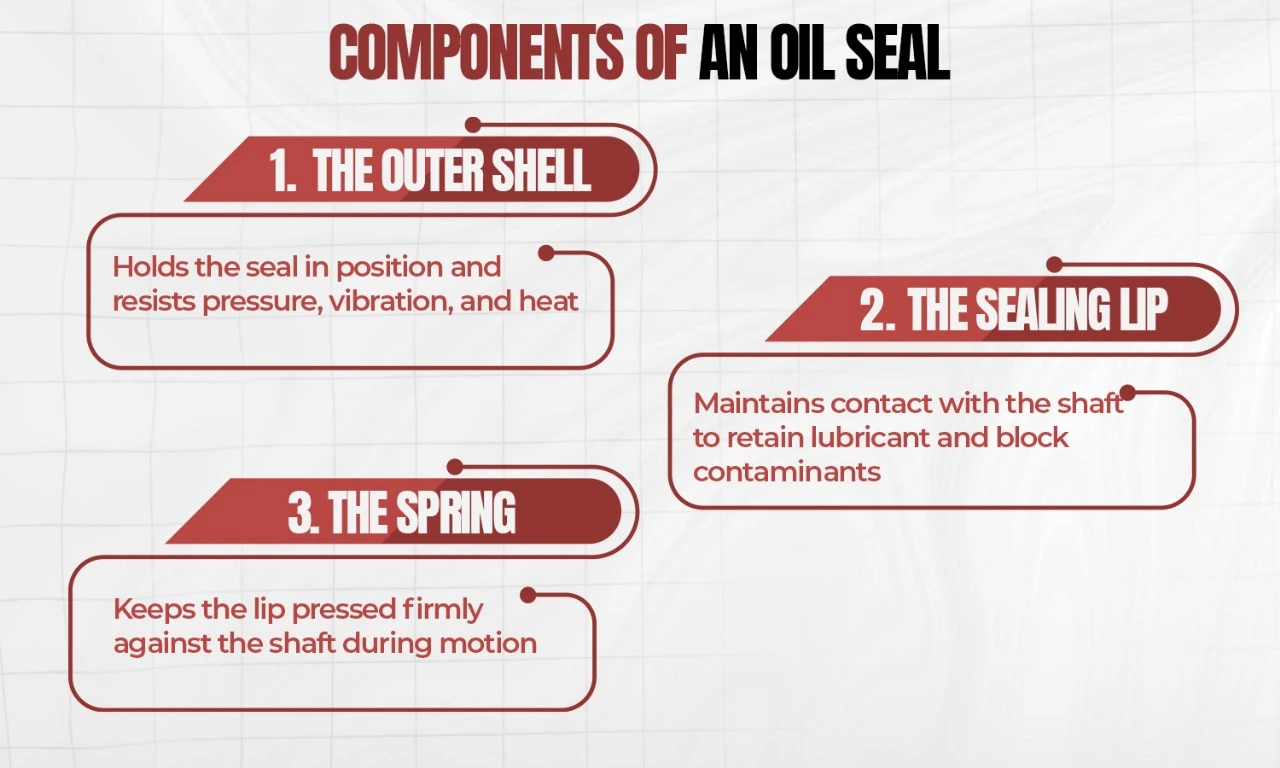
Components of an oil seal

Conclusion

The components of an oil seal—outer shell, sealing lip, and spring—work in unison to protect critical machinery. Each part is engineered to endure high speeds, temperature variation, and abrasive environments. Whether it’s oil seal design for automotive systems or equipment in heavy industries, the right combination of materials and dimensions matters. Deepee Rubber’s oil seals are designed with industry-specific performance demands in mind, offering high-grade sealing solutions for manufacturing, heavy machinery, and automotive applications.

Key Takeaways

  • Oil seals are made of a shell, sealing lip, and internal spring.
  • Each component serves a distinct function to prevent leaks and resist wear.
  • Oil seal design depends on application speed, pressure, and chemical resistance.
  • Accurate oil seal dimensions ensure long-term equipment efficiency.
  • Deepee Rubber delivers precision-engineered seals for industrial reliability.

Frequently Asked Question

An oil seal consists of a metal shell, rubber sealing lip (NBR, FKM, or silicone), and a spring to maintain contact pressure.
The outer shell ensures fit and support, the sealing lip prevents fluid leaks, and the spring maintains consistent shaft contact.
Shells use stainless or carbon steel, lips use NBR or FKM, and springs are typically stainless steel.
It forms the main barrier against leaks and debris, crucial for machinery performance.
Most dynamic seals include a spring to enhance sealing pressure, though static applications may not require one.

Table of Contents

Table of Contents

Introduction

Oil seals are essential for preventing lubricant leakage and blocking contaminants in rotating machinery. Choosing the right seal begins with understanding the components of an oil seal each designed for durability, performance, and precision. The components of an oil seal are often overlooked, but they play a key role in the reliability and service life of industrial equipment.

What is an Oil Seal Made Of?

An oil seal is composed of three core elements – an outer shell, a sealing lip, and a spring. Each part contributes uniquely to the function and resilience of the seal. Understanding the components of an oil seal helps engineers match the product to specific performance requirements.
  • Shell: Gives structural support
  • Lip: Provides a flexible sealing barrier
  • Spring: Maintains contact pressure for effective sealing
These parts of an oil seal work together to prevent fluid leaks and contamination in high-speed industrial environments.

What Are the Main Components of an Oil Seal and Its Functions?

Understanding the purpose of each part is critical for selecting a seal that fits specific industrial needs. Below is a deeper look at each component based on standard oil seal construction. Whether for OEM systems or aftermarket replacements, selecting oil seals with the right design ensures long-term equipment reliability.

The Outer Shell: Structure and Material

The outer shell is the rigid casing of the oil seal, giving it structural integrity and a secure fit. This is one of the primary components of an oil seal that ensures secure installation under varying operating conditions.
  • Material: Stainless steel or carbon steel
  • Function: Holds the seal in position and resists pressure, vibration, and heat
  • Relevance to Oil Seal Construction: Acts as the mechanical anchor inside the bore

The Sealing Lip: Ensuring Leak-Proof Functionality

This is the most important part of the oil seal, creating a tight, flexible barrier against fluid loss. It’s a crucial element in the overall oil seal design and directly influences performance under thermal and chemical stress.
  • Material: Nitrile rubber (NBR), fluorocarbon (FKM), or silicone
  • Function: Maintains contact with the shaft to retain lubricant and block contaminants
  • Connection to Oil Seal Design: Lip angle and material determine sealing efficiency
ALSO READ : Top 5 Benefits of Using Oil Seals

The Spring: Maintaining Contact and Pressure

A garter spring supports the lip’s function by applying radial force. Among the components of an oil seal, the spring is what keeps the sealing lip responsive to motion and wear over time.
  • Material: Corrosion-resistant stainless steel
  • Function: Keeps the lip pressed firmly against the shaft during motion
  • Impact on Oil Seal Dimensions: Adds dynamic adaptability to misalignments or wear

Summary Table: Parts of an Oil Seal

Components of an oil seal

Conclusion

The components of an oil seal—outer shell, sealing lip, and spring—work in unison to protect critical machinery. Each part is engineered to endure high speeds, temperature variation, and abrasive environments. Whether it’s oil seal design for automotive systems or equipment in heavy industries, the right combination of materials and dimensions matters. Deepee Rubber’s oil seals are designed with industry-specific performance demands in mind, offering high-grade sealing solutions for manufacturing, heavy machinery, and automotive applications.

Key Takeaways

  • Oil seals are made of a shell, sealing lip, and internal spring.
  • Each component serves a distinct function to prevent leaks and resist wear.
  • Oil seal design depends on application speed, pressure, and chemical resistance.
  • Accurate oil seal dimensions ensure long-term equipment efficiency.
  • Deepee Rubber delivers precision-engineered seals for industrial reliability.
Frequently Asked Question

An oil seal consists of a metal shell, rubber sealing lip (NBR, FKM, or silicone), and a spring to maintain contact pressure.
The outer shell ensures fit and support, the sealing lip prevents fluid leaks, and the spring maintains consistent shaft contact.
Shells use stainless or carbon steel, lips use NBR or FKM, and springs are typically stainless steel.
It forms the main barrier against leaks and debris, crucial for machinery performance.
Most dynamic seals include a spring to enhance sealing pressure, though static applications may not require one.
Share this story: